
On May 25 and 26, 2026, Universidad del Rosario welcomed the Consortium for Global Health, an academic alliance of ten universities in Canada, the Netherlands, Colombia, India, Thailand, Japan, Norway, the United States, Sudan and Bangladesh, whose central purpose is to advance education and research in global health from a transdisciplinary and intercultural perspective.
The Advisory Board Meeting on May 25 was opened by Rector Ana Isabel Gómez, who underscored in her remarks that universities like those forming the Consortium demonstrate that it is possible to build genuine collaboration across cultures, disciplines and diverse geographies. From the challenges of climate change and its implications for health, to antimicrobial resistance and emerging epidemics, the Rector noted that "none of these challenges can be solved by a single country, a single university or a single discipline". She was joined by the Dean of the School of Medicine and Health Sciences, Dr. Juan Mauricio Pardo.
The event was also supported by the Vice Presidency for International Affairs (Cancillería), for whom this gathering is a concrete expression of the university’s internationalization strategy and its engagement with the global agenda for sustainable development. As Sandra Guarín, Vice President for International Affairs, stated: “the Consortium’s presence in Bogotá represents precisely the kind of strategic international alliance that positions Universidad del Rosario at the intersection of global knowledge networks and the most pressing challenges of our time".
The Consortium's Advisory Board brings together leaders in public health, international policy and health equity from across several continents, among them Colombian epidemiologist Gabriel Carrasquilla, Vice President of the Colombian National Academy of Medicine and one of the country's most recognized voices in public health.
"The opportunity for students from Africa, Asia, Europe, North America and Latin America to learn together in the same virtual classroom represents far more than an educational innovation. It represents a profound transformation in the way we understand education and global health". — Rector Ana Isabel Gómez, welcome remarks to the Consortium, May 25, 2026
The Rosario delegation at the technical meetings was led by Professor Ángela María Pinzón Rondón, Director of the Global Health Institute, who also championed bringing this meeting to our university and who is the institutional representative to this network. Other participants were Professor Leonardo Briceño Ayala, Head of the Public Health Research Group, and Professor María Catalina Sánchez, co-director of the Master’s in Public Health.
The Partners’ Operational Meeting on May 26 addressed the components of the joint academic program and opened a working session dedicated to strengthening research collaborations among the ten partner institutions. Discussions also centered on expanding the visibility of student research across the network, opening pathways for joint thesis supervision and enabling more students to complete electives at partner universities in different countries.
The ten Consortium partner universities
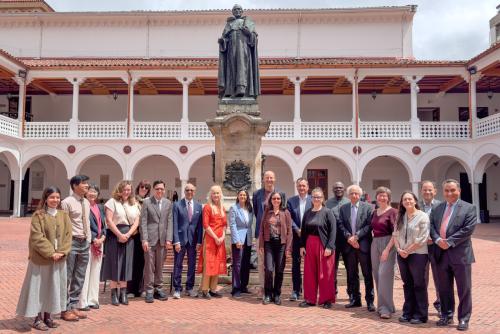
Universidad del Rosario’s partnership with the Consortium dates to 2017, when the institution began offering its Master of Public Health in coordination with the programs of partner universities. Since then, Rosario students have had access to international courses in global health, and students from partner universities have been able to complete their elective in Community Health in Vulnerable Communities in Bogotá. Universidad del Rosario is the only Latin American institution in this network.
Over the course of this relationship, Universidad del Rosario has developed student and faculty mobility with key Consortium partners, most notably McMaster University, Maastricht University and the University of South-Eastern Norway. These alliances, born directly from the Consortium network, have enabled sustained academic exchange that extends well beyond the shared curriculum. The depth of collaboration has evolved to the point that the institution joined fellow Consortium members in constructing a joint proposal for a Capacity Building in Higher Education (CBHE) Strand 2 project under the 2025-26 Erasmus+ call, titled Networking Education, X-regional learning and Up-skilling for climate-related Stresses on HEALTH — NEXUS HEALTH. The project seeks to create durable academic mechanisms that enhance comparability, quality assurance and collective learning, enabling contextually grounded climate–health education to be sustained locally and adapted by other climate-vulnerable regions in Asia and Latin America.
Hosting the Consortium in Bogotá is a recognition of the journey of nearly a decade: of the bonds of trust built with institutions across four continents, of the strength of joint academic programs, and of the university’s commitment to the great challenges of population health. It is also a look ahead. With new research collaborations on the horizon, expanded opportunities for joint thesis supervision, greater visibility of student work across the network and growing access to electives in multiple countries, Universidad del Rosario consolidates its place as a bridge between Latin America and the global academic community in health. The Consortium is, in itself, a living demonstration of how global health actually works: the great health challenges of our time — from pandemics to the climate crisis — are globalized, interconnected problems that demand collective, intercultural responses. Working across ten countries and four continents, the network embodies the kind of respectful, collaborative approach that global health not only teaches, but requires.
The Consortium for Global Health was originally established as a partnership between McMaster University and Maastricht University and has grown to include ten institutions across ten countries. More information: gh-consortium.org