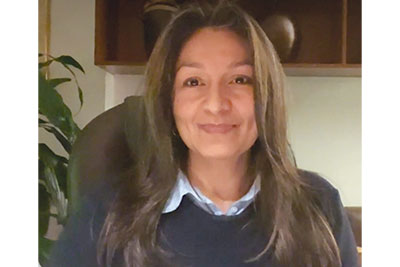
Nothing comes out of nothing” is a phrase attributed to the Greek philosopher Parmenides, and what better example for this premise than to talk about the creation of the project Rhapsodies of recovery in post-COVID key.. The story begins in early 2021. Ana Garzón, or “Anita” to her family, a wife, mother of two teenagers and sister of the occupational therapist in the School of Medicine and Health Sciences at Universidad del Rosario, Karim del Rocío Garzón, was admitted to the intensive care unit of the Shaio Clinic (Clínica Shaio) in Bogotá, due to Covid-19. There were weeks of anxiety and worry for family and friends, as they could only receive news of her through a video call from the doctors who treated her
“She was discharged and returned to home. At that time she had to do the pulmonary rehabilitation sessions through the virtual platform Zoom, as her cardiopulmonary system had been severely affected,” recalls Professor Karim. “She started to participate and I managed to accompany her in some sessions. Suddenly I realized that she was starting to get tired and feel exhausted, both physically, by the aftermath of the disease, and mentally, due to the confinement and monotonous sessions.” Karim says that her mood began to decline, not only because she was infected, but also due to the forced doctor-patient relationship established through virtual means. Therapies like blowing a ball and holding her breath were treatments that felt did not need accompaniment. At the same time, the clinical examinations and surveys she underwent as a patient of a virus, that was still quite unknown made her feel more like an object of study than a normal person, one who felt fear, anguish and stress, and who needed the medical staff to be more empathetic with her situation.
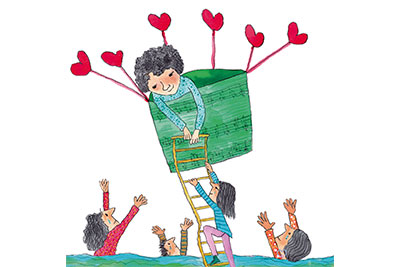
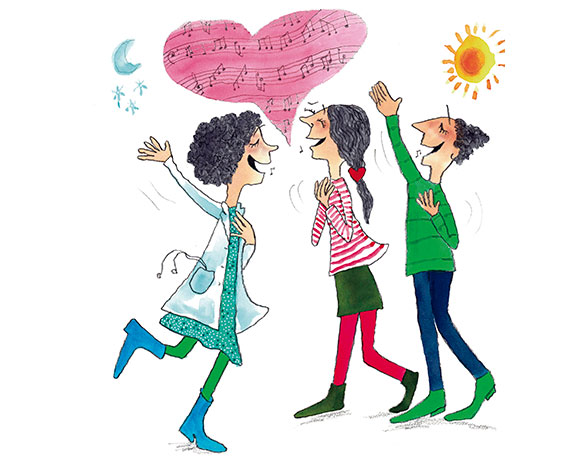
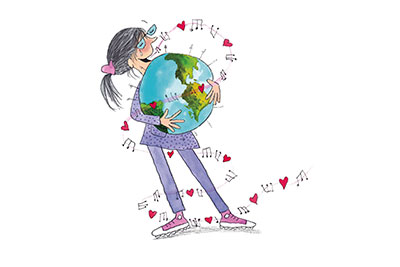
The results of the project were more than just teamwork: a poem was created, the unpublished song Time to Dream, an illustrated book and a virtual interactive module were created.
From Karim's vision as an occupational therapist, Anita's situation is no stranger to a post-COVID reality for other patients and their families. The “objectification” of the patient, as she calls it, gave her the opportunity to consider the creation of a comprehensive therapeutic program that unites physical and mental health, so that the person diagnosed does not give up medical treatment and at the same time feels that their emotions are validated during the process.
looked for a different alternative that would complement the therapies from a more human perspective; something that would happen through art,” Karim explains. “I have no knowledge of art, but I am a fan of all types of its expressions. So, I checked, I researched and I found that singing is a very nice opportunity to work all that cardiopulmonary aspect of individuals. That is, it is not merely an instrumental activity that only makes you hold and release your breath, but it has an emotional and spiritual complement for people. I reviewed the scientific literature, not precisely with references to Covid-19, but on the articulation between singing and cardiopulmonary health. Then I thought that this would be a wonderful tool for people who suffered from the disease to achieve, through singing, another type of well-being,” adds the specialist.
The circle of singing
The idea of comprehensive respiratory therapy had to be built together. Karim del Rocío, in addition to being an occupational therapist, is a doctor and an associate professor in the School of Medicine and Health Sciences at Universidad del Rosario, where she sought support to develop her project from the The Faculty of Creative Studies.. There she met the composer and professor of Musical Theater Patricia Moncayo, who after listening to the idea of a comprehensive post-covid program, contributed her knowledge in musical creation, breathing and composition to carry out Karim's goal.
“Patricia tells me: ‘Karim, in the world of singing there is a figure called the circle of singing, which has different nuances and different developments, but all framed in this objective.’ So we proceeded to give an identity to that circle,” Karim says. The singing circle is a narrative interconnection resource that is separated by modules to help improve, step by step, breathing, voice management and group harmony.
Likewise, Universidad del Rosario, within the framework of the RUTA 2025, vision, launched the first edition of thee Innovation 2021 program: “Training teachers for teaching-learning in the STEAM model in times of transformation,” which promotes the participation of teachers in strategies and, projects that generate agents of change, for the social good and the university community. The agents of change are people trained by these teachers who promote the knowledge obtained in the community where they live. There, Karim and Patricia presented the proposal“Rhapsodies of recovery in post-covid key.”.
For the professor of Universidad del Rosario, Karim del Rocío Garzón, the “objectification” of the patient, as she calls it, gave her the opportunity to consider the creation of a comprehensive therapeutic program that unites physical and mental health, so that the person diagnosed does not give up medical treatment and at the same time feels that their emotions are validated during the process.
This initiative aimed to work with student volunteers from different faculties of the university and prepare them as agents of change for post-covid patients. “The idea in developing this project was not that we were all respiratory therapists, but that it became a civic commitment, that is, that any citizen could generate an accompaniment, an understanding of the reality that these patients live, whether an urban designer, a psychologist, a journalist, etc.”, she emphasizes. In addition, Karim narrates how she began to receive support from other programs at the university; such is the case of the Psychology program, through Professor Ximena Palacios, who contributed knowledge from the concept of salutogenesis, which is the relationship between the well-being of people and the management of emotions under adverse circumstances, such as stress, and that can trigger some physical illness
Agents of change
Professor and composer Patricia Moncayo says that this project was built with six modules or “acts”, as they called it during the activity: start and purpose; exploration; discovery; achievement; assembly and performance. Each module had two sessions of one hour each. However, when the project started, face-to-face care was not yet an option, given the restrictive measures of the pandemic. That is why they implemented the program and their call to action through virtual meetings. One aspect that surprised its creators was that the final team was made up entirely of women from different programs and faculties: musical theater, psychology, physiotherapy, speech therapy and urban design. Patricia knew that the biggest challenge in the program was the different levels of knowledge about singing that the participants had. However, again, Karim was surprised: he found that there were no judgments, criticisms, or rivalry between them; on the contrary, the activity promoted trust and security in what they were doing. “For them,” says Karim, “it was more important to know that their contributions were recognized in a space, and that was what we wanted to achieve with our agents of change. That we feel like makers or builders of lives working as a team for the benefit of others.”.
Furthermore, the results of the project were more than just teamwork: a poem was created, work of the psychologist, assistant professor and co-author of the project Ángela Vera; the unpublished song Tiempo de soñar, already registered with copyright, in which the teachers and students participated during the activity; an illustrated book whose drawings were elaborated by Professor Olga Cuéllar; and a virtual interactive module by the team of the Resource Center for Learning and Research of Universidad del Rosario,,thanks to which they captured in themselves a life experience while sharing their postcovid stories. From all this a great friendship arose.
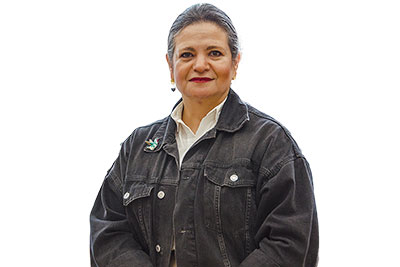
After listening to the idea of a comprehensive postcovid program, Patricia Moncayo, composer and professor of Musical Theater in the Faculty of Creative Studies at URosario, contributed her knowledge in musical creation, breathing and composition to carry out the project.
Humanity was present
Although Anita, the sister of Professor Karim del Rocío, is not linked to the university project, she was always present in the process of creating, executing and evaluating the results. The authors had the opportunity to interview her as a patient for the development of the themes that the circle of singing would address.
“I think Anita is really the backbone of the start of this project,” Patricia says. “Being able to work with her made us see a much bigger spectrum about how really a person who has been in such a vulnerable, at-risk condition can be so resilient, so responsive, and can generate so much cohesion from their painful experience. It really became a kind of pre-teaching at the start of our project, and in large part all the design we achieved of the work sessions for the students, considering that the students are agents of change. Anita embodies this as well.”
Karim shares that when Patricia learned Anita's story she was moved and volunteered to help her continue in the respiratory therapy sessions through singing, to which Anita efusively replied: “Karim, this is something else,” meaning the therapy produced a sense of well-being that was very different and better than what she had previously experience.
However, it is not only Anita who testifies to the excellence in the results of the hard work of the team led by Karim. On November 3, the ColombianAssociation of Faculties of Psychology (Ascofapsi) awarded them with the 2023 Teaching Innovation Award in the group modality: “We were honored with first place after submitting our experience in a call for training programs in Psychology,” concludes Karim.
The call for these awards for teaching innovation was made at the national level with the aim of highlighting the contribution of teachers to training in the field of psychology, and their contribution to knowledge through innovation and the creation of programs that contribute to the mental health and well-being of the population
It is ‘Time to Dream’
The song Tiempo de soñar (Time to Dream) was composed by the students who participated in the project, supported by Patricia Moncayo, as a singing coach. The melody, vocals and accompaniments were a team effort between the students, Patricia and the music teacher Oscar Cuesta from the Faculty of Creative Studies.
“For the song we did all the paperwork before the Ministry of the Interior to obtain the corresponding copyright. This way, students can put into their resumes that they are the authors of a song,” Karim says. Therefore, Tiempo de soñar also has a video performance that shows the students singing. And if it is the picture book, you can access it for free through the following QR codes.