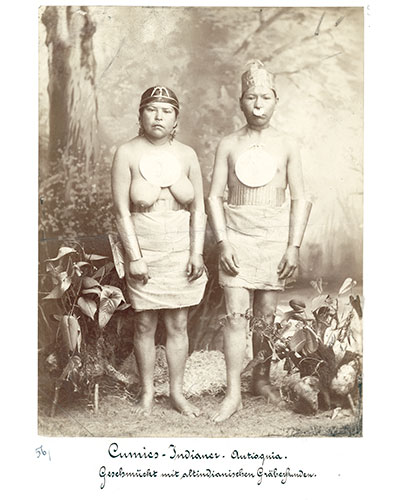
In the background, a curtain that simulates a Eu�ropean forest. On the ground some prop plants and straw trying to look like a meadow. They, with bare torso and feet, have hanging breasts and noses. As if mesmerized, their gazes turn to a ca�mera that has captured the moment forever. The caption says that they are indigenous Cumics from Antioquia and that they wear pre-Colombian finds. Every detail of this photograph was designed to respond to the curiosity of those who have never seen an indigenous Colombian
Like this one, more than 2500 images make up the collection that volcanologists Alphons Stübel and Wilhelm Reiss acquired during their voyage through South America from early 1868 to 1877. A tour in which they intended to follow in the footsteps of the great explorer Alexander von Humboldt. The researchers toured the country with the intention of reaching the Chimborazo volcano (Ecuador) and on the trip acquired the photographs that are now part of the Alphons Stübel Collection of the Leibniz Institute of Regional Geography in Leipzig and the Reiss Collection that rests in the Reiss-Engelhorn Museum in Mannheim (both in Germany).
“In recent years, Colombia is making a great effort to build memory, but not to build history,” summed up Sven Benjamin Schuster, professor in the School of Human Sciences at Universidad del Rosario in dialog with this publication, noting that these images aim to show fragments of this nation that still does not know itself and that should value photographic archives as a reference, not only of who we are now, but of what we have been.
Recently historians Sven Benjamín Schuster and Alejandra Neva Oviedo, professors in the School of Human Sciences at Universidad del Rosario, managed to collect in digital format the more than 200 images from these collections that were acquired by travelers in Colombia between 1868 and 1870, but also later. For example, the collection includes a series of images of the stone statues of St. Augustine taken by the Antioquia photographer Emiliano Jaramillo that were acquired in 1891, that is, about 14 years after the end of the trip through South America
It is worth mentioning that some of the images belonging to the Stübel Collection were already exhibited at the Luis Ángel Arango Library in 1996 in the framework of the exhibition “n “Behind the Traces: Two German Travelers in Latin American Lands”, while the photographs of the Reiss Collection have never been presented in the country.
A Both collections are little known by the academic community and most of their originals do not yet belong to the national historical heri�tage. However, today they can be seen in one of the virtual exhibitions offered by Universidad del Rosario (https://urosario.edu.co/ exposiciones/coleccion-alphons-stubel) or in the pages of the book “Colombia: un viaje fotográfico. Las colecciones de Stübel y Reiss (siglo XIX), Colombia: a photographic journey. The collections of Stübel and Reiss (19th century), a beautiful editorial testimony of this academic exercise.
Historians were struck by the fact that these images have been ignored or unknown to the country for so long. “In recent years Colombia is making a great effort to build memory, but not to build history. These images reflect a nation that does not yet know itself and that should value photographic archives as a reference, not only of who we are now, but also of what we have been,” says Schuster.
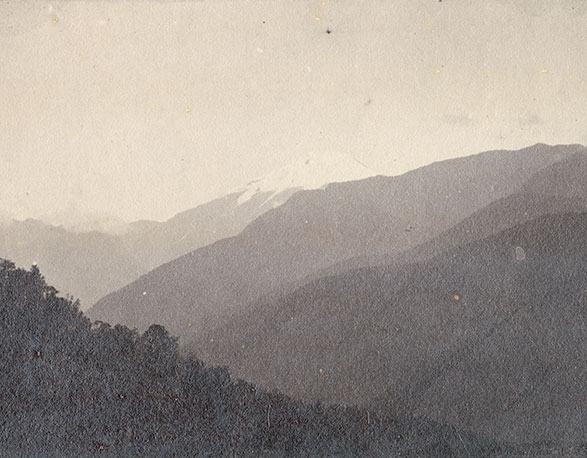
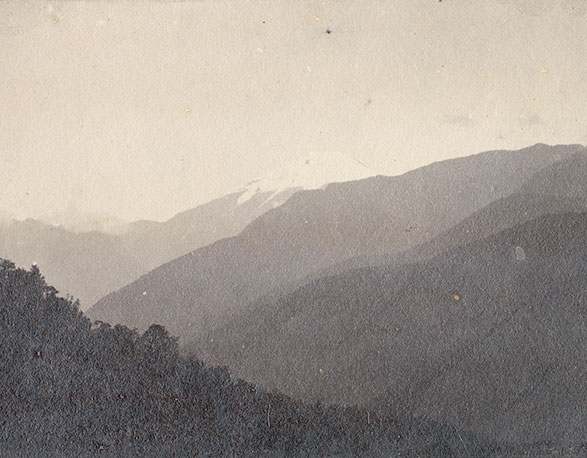
“The Tolima volcano, valley of the Combeima River.” Original source: Alphons Stübel Collection, Leibniz Institute for Regional Geography, Leipzig (Germany)
Motivated by this reflection, the researchers managed to collect the collection that the German adventurers put together during that trip together with the notes they wrote in their journals, in an effort to ‘relook’ these photographs taken in a period of the country characterized by civil wars, territorial disputes and the construction of a national identity.
The book Colombia: a photographic journey. The collections of Stübel and Reiss (19th century) has attracted the attention of the Colombian academy and the general public, and have become a fundamental piece to understand the socioeconomic, political and cultural reality of the second half of the 19th century of Colombia. Historians insist that research into the country's photographic past is just beginning and that images collected by volcanologists can be a new source of knowledge about the country's graphic past.
Searching for El Dorado in volcanoes
Alphons Stübel and Wilhelm Reiss came to Colombia for many reasons. At that time, volcanology was an attractive science with a large field of study, and the Germans considered the Andes and their final trifurcation in Colombia as a kind of treasure; a large number of geographical accidents hardly documented and could mean, simply, the transcendence in their research universe. They thought it would take three months in the countrybut they lived and studied its geography for more than two years.
Reiss was a German geologist and explorer, born in the Grand Duchy of Baden. In 1872 he became, together with his Colombian servant Ángel María Escobar, the first person to successfully climb the summit of the Cotopaxi volcano (north of Ecuador). For his part, Stübel, born in the Kingdom of Saxony, studied chemistry and mineralogy at the University of Leipzig, and together with Reiss was the first crown the summit of the Tungurahua volcano (equally, on Ecuadorian soil), in 1873. Both came from families of successful businessmen, so they had enough sources of financing to cover the requirements and demands of their expedition, whose final destination was the Chimborazo. In Colombia, they climbed and measured the volcanoes of Tolima and Huila, among others
During the tour they discovered, among many finds, that much of the height measurements that Humboldt had made official were wrong and that existing topographic maps, such as those made by the Choreographic Commission in the middle of the century, were unreliable. In his expeditionary transfer, the photos accumulated along with the measuring instruments. Perhaps at first they were souvenirs, but later they became important pieces of the journey and a way to show fragments of a country unknown to their European peers.
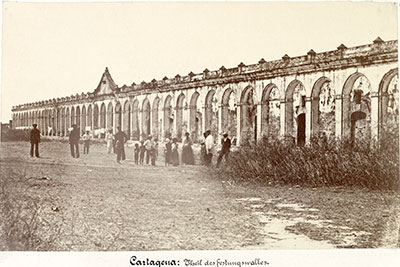
Cartagena: Palace of the Inquisition.” Original source: Alphons Stübel Collection, Leibniz Institute for Regional Geography, Leipzig (Germany).
A journey into the 19th century
The mountain curves of the Central Mountain Range repeat themselves, some darker than the others. The photographic technique of that time does not allow to detail the sky that is observed in the totally white image; but in the back�ground you can guess the Nevado del Tolima volcano, still white, still stunning. The researchers of Universidad del Rosario discovered that the photo was commissioned by Stübel; he wanted to remember this point of his journey and the roads outside Honda, where Humboldt also passed.
The photograph, then, was taken in 1873, as the caption below the image recalls, five years after the start of the two explorers' journey. Between the Port of Santa Marta and the city of Honda there are 863 kilometers. Their journey seemed to them endless. Later, the photograph was used as the basis for a large-format painting. It was exhibited at the Museum of Comparative Geography in Leipzig from 1905, since at that time Stübel considered that photography failed to capture the beauty of the landscape, nor the odyssey of the journey: “Landscape photography can never reproduce the particularities of a mountain’s structure as sharply as a geologist does with pencil on paper.”.
The pose behind the photo
The first thing you see is the waterfall that breaks the landscape. Its strength when crashing into the rocks, the speed of the waters cannot be documented with the cameras of the time so in the image it seems just a white spot in the middle of the texture of the mountains. In the center of the image, at the top, a group of people organized in lines pose for a distant camera. The orders should have been clear: these people try not to move for a few minutes so that the camera captures them in detail. There are 75 people used to moving between cliffs and the darkness of mine tunnels. They pose for a photographer allegedly hired by businessman Gustave Lehmann, who at the time controlled the emerald mines in Muzo (Boyacá) and who gave this photograph to the volcanologists.
Reiss and Stübel made small excursions to places near the original route, among them, the mines of Muzo. Reiss' field diaries describe the behind-the-scenes aspect of the image, the sense that Muzo was a dilapidated town and that the mining concession did not benefit state coffers or local development:
“On the first day of our stay, the harvest was huge, as several hundred crystals were found, among which were many small, but also two the size of a fist. Lehmann assured us more than once that days like these were the absolute exception and asked us not to talk about this in Bogota. To mention this character one last time, I would like to note that Lehmann's executive talent boilsdown to pocketing even the smallest granite of emerald with remarkable greed.”
The work of professors Schuster and Neva allowed us to conclude that the images of the mines of Muzo were taken on commission by Lehmann himself, who gave a copy to the volcanologists so that they could publish the mining concession.
By carefully analyzing the images and Stübel's notes on them, the researchers were able to see that the working conditions of the mine differed from those documented in the photographs. This also makes us think on the documentary uses of this material in which all the components of the scene are intentionally placed and where the photographer's vision of reality is imposed.
The publication of the researchers of Universidad del Rosario includes a judicious selection of engravings and illustrations with which the volcanologists documented part of their experiences or observations during the tour; those occasions when they preferred to trust their pencil, instead of staying only with what the eye of the local photographers of the time captured through their cameras.
“Our eye gets much less tired when observing individual drawings, compared to the monotonous brown of mediocre photographs. In these hard-to-reach regions, only a traveler who spends a lot of time and dedication could take photographs of great perfection, systematically.”
“Indigenous Cumics, Antioquia.” Original source: Alphons Stübel Collection, Leibniz Institute for Regional Geography, Leipzig (Germany).
St. Augustine, the forest gods
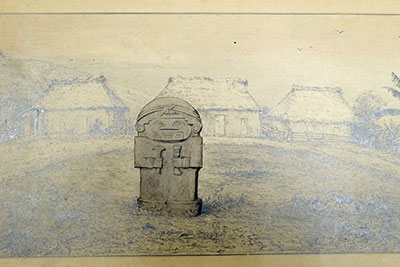
In the middle of palms and trees there is an anthropomorphic sculpture of triangular appearance. Its eyes, nose and teeth are highlighted with fangs. In the background there is another sculpture, this one full-length; in his hands he holds some objects that seem sacred. The detail in the representation of the fauna and sculptures in the illustration drawn by Stübel gives clues to his interest in these areas of study, and perhaps it was here that his passion for archeology was aroused.
Leaving Bogotá to the southern Colombia, the travelers recognized that their scientific interests were different and for this reason they agreed to take a break to meet again later in Popayán. During this segment of the tour Stübel decided to deviate towards the Eastern Plains, despite multiple recommendations not to do so by Reiss and other notable Bogotans, due to the fearsome endemic fevers that plagued the region during those days.
Stübel ignored the advice and set off for the vast area, where he would witness an attempted coup d'état, which he would later recount in his diaries; but he also caught a tropical fever that would accompany him for the rest of his days. Once he was relieved, he crossed Ibagué to the south of the country, crossed the Huila and in San Agustín he found traces of some pre-Colombian cultures.
Fascinated by the sculptures of the ancient peoples of St. Augustine, Stübel hired some inhabitants of the region to help him unearth what he called “forest gods.” Upon unearthing one of the figures discovered that it was actually a stone sculpture about 4.5 meters high.. He also found other pre-Colombian archeological pieces whose illustrations and photographs were part of the objects exhibited in his museum in Leipzig.
An excerpt from his blog Stübel explains what the place was like: In the ravines the water falls in wonderful waterfalls on the masses of dark lava. On a small highland, the fields of the indigenous people are spread, which are remarkably well cared for. The beauty of the wild scenery cannot be described in words.”.
All the photographs and illustrations that they accumulated during the trip were a way to carry with them much of their adventure when they returned home and to support the measurements they were making, although they were very aware that there was no way to count with fidelity what they had seen and experienced.
"St. Augustine”, drawing by Alphons Stübel. Original source: Alphons Stübel Collection, Leibniz Institute for Regional Geography, Leipzig (Germany).
The Germangaze, the Colombian photographs
Together again in Popayan, the Germans visited multiple photographers who had settled in the city. They were truly surprised by the number of photographic studios present in the city and by the greatness of the photographic series that were marketed there
To identify the origin of the images, Schuster and Neva Oviedo often relied on the captions of photos, usually signed by authors such as Demetrio Paredes, photographers from Cauca such as Mariano Cobo Rincón, Mariano Ramírez and José María Fernández (Asociación Ramírez & Fernández). However, in other cases the photos seemed to be a commission, as if Stübel and Reiss were traveling accompanied by a photographer who recorded with his camera what they discovered or found interesting. Such are the examples of the images of a banana plantation in Tolima or of the house they shared in Bogotá in 1868
These photos were taken with different techniques and formats, from landscape photographs or panoramas of cities that showed the frames of the square, to portraits made in studios where businessmen, intellectuals, politicians and also indigenous and peasant posed
This fantastic collection resembles what the Choreographic Commission of the New Granada,, led by Agustín Codazzi in 1850, tried to be: a way of defining what Colombia is and the people who inhabit it.
Upon his return, all photographs, illustrations, and even some objects, would be exhibited in Leipzig. It took just under a century, in 1996, for those acquired or commissioned by Stübel to return to Colombia. This publication by Universidad del Rosario aims that the images of Stübel and Reiss, which are presented and analyzed for the first time as a whole, return to their country of origin, that are seen by new audiences and that are a symbolic and popular part of the history of Colombian photography.
To this end an agreement was reached with the Leibniz Institute of Regional Geography, where the original photographs of the Stübel Collection rest. Thanks to this agreement, which had the support of the former director of the Cultural and Historical Heritage Unit of the URosario, Dr. Luis Enrique Nieto (1947-2020), the historical archive of the University has digital copies in high resolution in view of all those interested in the virtual exhibition