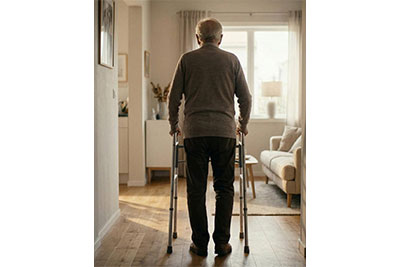
Doña Rosa, 85, is one of the most beloved residents of a nursing home in Bogotá. Despite living with a neurocognitive disorder (dementia), she still wishes to participate in community activities, such as going to the corner store for snacks and attending the parish bingo games organized by the facility. However, physical frailty, an increasing risk of falls, and spatial disorientation have begun to limit her ability to engage in the activities that are so meaningful to her.
Rosa’s hips and lower limbs ache when she rises from the armchair where she spends her mornings watching television. In addition, she has difficulty communicating her needs and desires, which causes her frustration. Her walks have become unsafe, and the fear of losing her balance or not knowing how to return home has further limited her social participation.
Rosa’s story is not isolated. According to 2021 data from the National Administrative Department of Statistics (DANE), approximately 7.9 million people aged 60 and older live in Colombia—a figure that continues to rise and already accounts for nearly 15% of the total population. For many of them, mobility has become a primary determinant of autonomy, social participation, and quality of life, particularly when frailty, cognitive decline, or other sequelae of neurological diseases are present.
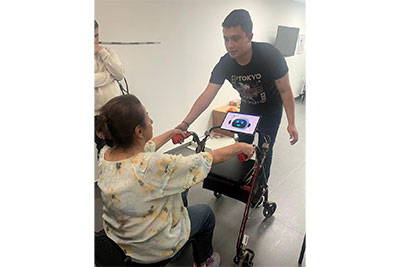
The walker has already been tested by older adults with limited mobility, whose user experiences have contributed to improving its design.
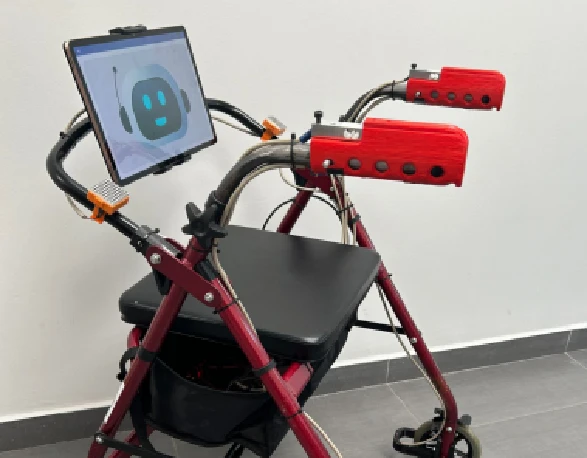
Researchers at the Universidad del Rosario are conducting a study—funded through the institution’s internal resources—that explores the intersection of aging, technology, and personal autonomy. The project aims to transform an everyday object—the walker— into a smart assistant that enhances the mobility and independence of older adults within their communities.
From Physical Support to Cognitive Assistance
The project, titled Development of a Multimodal Interface for the Effective Implementation of Smart Walkers in Gait Assistance Settings for Older Adults, is led by Mario Jiménez, Ph.D. in Electrical Engineering and senior professor at the School of Science and Engineering at the Universidad del Rosario.
Jiménez explains that the distinction between a traditional walker and a smart walker lies not only in the incorporation of sensors or electronic components, but also in the role the device plays during movement.
“A smart walker can be defined as a device that makes decisions based on information obtained from both the user and the surrounding environment,” explains the researcher. “Whereas, with a traditional walker, the entire cognitive load rests on the individual, this device also functions as a cognitive assistant, helping the user decide where to go, when to stop, and how to avoid obstacles.”
Although similar solutions have existed for some time, the professor emphasizes that the project’s principal innovation lies in the integration of the multimodal interface, which enables the device to convey information in an adaptive and personalized manner through various sensory channels. This approach allows the device to support users not only physically but also cognitively, thereby assisting decision-making while walking.
What Does a Multimodal Interface Mean?
This project at the Universidad del Rosario integrates engineering with rehabilitation sciences. Martha Rocío Torres Narváez, a physical therapist and associate professor at the School of Medicine and Health Sciences, and Karen Aguia Rojas, an occupational therapist and assistant professor, serve as co-researchers. They explain that a multimodal interface enables useful information to be conveyed through multiple channels, adapting to each person’s sensory and cognitive abilities.
What sets this type of technology apart is its capacity to adapt to the user’s functional, sensory, and cognitive needs.
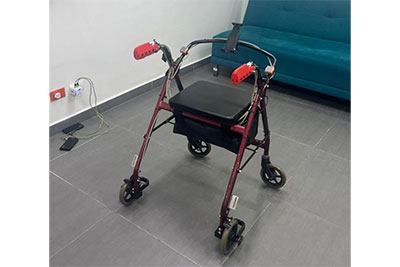
In this development, the interface integrates three primary channels. The visual channel employs illuminated arrows located on the walker’s frame to indicate direction, such as left, right, or forward. The tactile or haptic channel delivers instructions through vibrations in the handrails, allowing the user to navigate without requiring constant visual attention. The auditory-cognitive channel relies on voice commands and an interactive avatar hosted on a tablet, which accompanies the user’s movement and helps stimulate cognitive functions.
“What sets this type of technology apart from traditional assistive devices is its capacity to adapt to the user’s functional, sensory, and cognitive needs,” the researchers note. “It is not only about walking safely, but also about maintaining autonomy, participating in meaningful activities, and interacting with the environment.”
This approach is particularly valuable for individuals with neurocognitive disorders, impaired attention, or difficulties initiating and maintaining gait—conditions affecting people like Doña Rosa, as well as millions of others in Colombia.
A Global Gap in Assistive Technologies
The development of the Universidad del Rosario smart walker is part of a broader global challenge. According to the World Health Organization (WHO) and the Global Cooperation on Assistive Technology (GATE) initiative, only one in ten people worldwide has access to the assistive devices they need, such as walkers, wheelchairs, or hearing aids.
The situation is even more critical in lowand middle-income countries, where the unmet need for assistive technologies among older adults can reach up to 90 %. At the same time, projections from the United Nations indicate that by 2050, the population aged 60 years and older will double, significantly increasing the demand for mobility devices.
“A smart walker can be defined as a device that makes decisions based on information from the user and the environment,” explains Mario Jiménez, Ph.D. in Electrical Engineering and senior professor at the School of Science and Engineering at the Universidad del Rosario.
In Colombia, mobility is the most commonly reported functional limitation in older age. According to the Ministry of Health and Social Protection of Colombia, among older adults with a certified disability, physical disability affects nearly 73%, and the prevalence of cognitive impairment exceeds 46%—figures that underscore the urgent need for accessible solutions adapted to the local context.
Designing with People, Not Just for Them
One of the guiding principles of this project is user-centered design (UCD), an approach that involves not only the direct users of the walker but also caregivers, physical therapists, occupational therapists, and other health-care professionals.
Professor Mario Jiménez acknowledges that, for many years, engineering solutions were often developed without sufficient user involvement. Today, however, it is widely recognized that a technology can be technically sound yet fail if it is not accepted or understood by those who use it.
The researchers at the School of Medicine further note that many assistive technologies are abandoned because they are not intuitive, do not integrate into daily routines, or are physically uncomfortable. For users, such abandonment can lead to social isolation, reduced mobility, and loss of independence— outcomes that are the exact opposite of the technology’s intended purpose.
For this reason, the team has adopted conceptual frameworks such as the Human Activity Assistive Technology (HAAT) model, which integrates the user, the activity, and the context into the design process, ensuring that the resulting solution is both functional and meaningful in everyday life.
The project’s central innovation is the development of a multimodal interface—a system capable of conveying information to the user through multiple sensory channels in an adaptive and customizable manner. Rather than relying solely on the user’s physical strength or sustained attention, the smart walker assists with decision-making during walking.
From the Lab to Home
The project is currently in the usability testing and initial validation phase. Following the development of the prototype, the team conducted pilot tests at the Daily Life Laboratory at the Universidad del Rosario, a controlled environment that simulates everyday activities.
Subsequently, a descriptive cross-sectional study was conducted with four older adults residing in a long-term care facility, some of whom have moderate to severe neurocognitive disorders. These tests enabled a direct evaluation of human–technology interaction within a highly complex population.
The findings were used to refine the voice commands, the interaction with the avatar, and the synchronization among the different interface modalities. According to Mario Jiménez, this type of validation in real-world settings represents one of the greatest technological challenges, given the variability of surfaces, obstacles, and conditions at home.
“It is one thing to design for a laboratory and quite another to address ramps, uneven tiles, or confined spaces,” the researcher explains.
One of the project’s most notable aspects is its interdisciplinary nature, integrating engineering, physical therapy, and occupational therapy from the earliest stages of design.
“An engineer can develop robust hardware, but the health sciences ensure that this hardware is usable, safe, and clinically relevant,” note Martha Rocío Torres Narváez and Karen Aguia Rojas. “This synergy significantly increases acceptance and usability among end users.”
Furthermore, the researchers have exchanged experiences with similar research groups in other countries, such as Brazil and the United Kingdom, to compare results, explore cultural differences, and avoid challenges previously identified in other contexts.
A Potential Impact for Colombia
Although the smart walker is not yet ready for widespread implementation, researchers estimate that its development could benefit a significant segment of Colombia’s population of older adults, particularly those with limited mobility and cognitive decline.
By focusing on low-cost adaptations to conventional walkers, the project aims to overcome one of the primary barriers to smart technologies: their high cost. Unlike many high-cost international developments, this proposal seeks to transform existing devices into smart assistants without making them prohibitively expensive.
For individuals like Doña Rosa, technology of this kind could mean more than simply walking safely. It could help her maintain daily routines, reduce dependence on others, and retain a sense of control over her environment, even as her physical abilities decline.
The team has employed conceptual frameworks that integrate the user, the activity, and the context into the technology’s design, ensuring that the solution is both functional and meaningful in everyday life.
Despite this progress, researchers acknowledge that widespread real-world implementation is still some way off. Among the next steps are longitudinal studies to evaluate the walker’s use over time, user adherence, and the perceptions of caregivers and healthcare professionals.
It will also be necessary to generate robust evidence to support the recognition and inclusion of these technologies within healthcare systems, as well as to address challenges related to industrial production, standardization, and technical support.
“Our ultimate goal is for technology not to be a barrier due to cost or design, but rather a powerful enabler that ensures older adults can live independent and active lives,” the researchers conclude. In other words, older adults like Doña Rosa should be able to continue walking and participating in the activities they enjoy—not only with physical support, but also with intelligent assistance.